Abdullah ibn Abbas (radiyallahu anhuma) relates the following:
“The Messenger of Allah (sallallahu alayhi wa sallam) was the most generous of people. But when Jibril (alayhissalam) would meet him during Ramadan to review the Qur’an, his generosity would increase even further. At those times, he was more generous in doing good than a freely blowing wind.”
The month of Ramadan is the most virtuous and blessed of all months. Worship and good deeds performed during this time are known to carry greater reward and acceptance. This truth becomes clear when we observe the reverence and practice of the Prophet (sallallahu alayhi wa sallam) in this sacred month. To live Ramadan in accordance with the Sunnah, even for just one month, is to live those days as if one were beside the Prophet himself, and to taste the beauty and spiritual richness of his company.
Ramadan is the month of fasting. Fasting was made obligatory in the second year after Hijrah, and from that time until his passing, the Prophet (sallallahu alayhi wa sallam) observed nine Ramadans.
It is well known that Ramadan is also the month of charity, generosity, and helping others. In this month, the Prophet (sallallahu alayhi wa sallam) exerted himself even more in worship, good deeds, and acts of kindness than during any other time of the year.
But how did he fast? How did he take suhur and break his fast? What did he eat and drink? How did he spend his days, and what filled his time? With the intention of offering a practical example, we will summarize these questions in light of the hadith mentioned above.
What Did He Do in Ramadan?
When the crescent of Ramadan was sighted, the Prophet (sallallahu alayhi wa sallam) rejoiced. He would announce its arrival to his Companions and encourage them to make the most of its virtue and blessings. (Nasa’i, Siyam, no. 2106)
He would form the intention to fast each day of the month. Usually, he took suhur at home, together with one of his blessed wives. He ate only a small amount, a few dates, a bit of food if available, or even just a few sips of water.
At times, he took suhur with some of the Companions. It is narrated that once he took suhur with Zayd ibn Harithah (radiyallahu anh), after which they both rose to perform the dawn prayer. The time between his suhur and the Fajr prayer was roughly the time it takes to recite fifty verses of the Qur’an. (Bukhari, Sawm 19; Muslim, Siyam 9)
After eating suhur, he would pray the two-rak‘ah Sunnah of Fajr briefly, without lengthening it. He would then wait in his home until Bilal came seeking permission to give the call to prayer. Only then would he step out through the small rooms that adjoined the mosque and lead the prayer.
The Prophet (sallallahu alayhi wa sallam) would remain seated in the mosque after Fajr, remembering Allah until sunrise. A short while after the sun had risen, he would perform the Duha prayer, saying that whoever performs it receives a reward equal to that of Hajj and Umrah.
During the days of Ramadan, aside from the daily prayers, he tended to the needs of the Muslims, answered their questions, and resolved their concerns. He dispatched military units and expeditions to protect the Ummah and spread the message of Islam.
He spent the remainder of his time at home, serving his family, showing them affection, and gently sharing moments of lightheartedness. It is narrated that he joked with his wives while fasting, and even kissed them while still in a state of fasting. (Muslim, Siyam 71)
As sunset approached, he would engage in Qur’an recitation and supplication. When the call to Maghrib was made, he would ask his wives to bring him something to break his fast. He would first break the fast, then rise to pray.
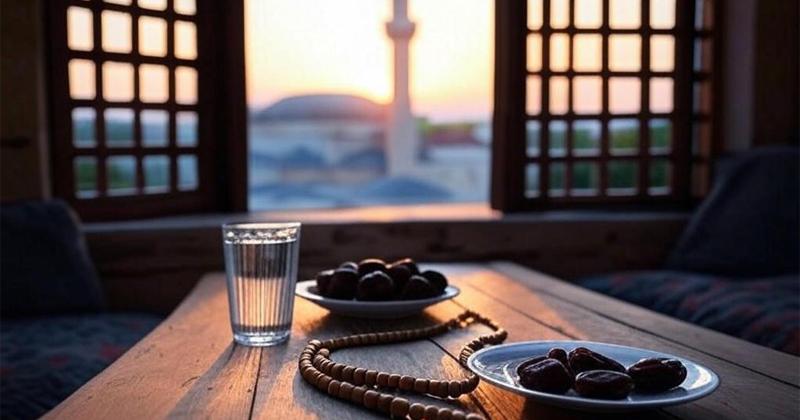
He typically broke his fast with a few dates or water. Anas ibn Malik (radiyallahu anh) said: “The Messenger of Allah (sallallahu alayhi wa sallam) would break his fast before praying. If fresh dates were available, he ate them. If not, he ate dry dates. And if neither were available, he drank a few sips of water.” (Abu Dawud, Sawm 21; Tirmidhi, Sawm 10)
His Evenings in Ramadan
After breaking his fast, the Prophet (sallallahu alayhi wa sallam) would perform Maghrib in the mosque, then return home. He would pray the Sunnah of Maghrib at home and sit with his family until the call to Isha.
When the call was made, he prayed the Sunnah of Isha at home, then returned to the mosque to lead the prayer. On three occasions, he led the Companions in Tarawih prayer. But afterward, he refrained from coming out for Taraweeh, fearing that it might be made obligatory upon the Ummah. (Bukhari, Tahajjud 25)
Once Isha was completed, he returned home and spent the night in prayer, standing as long as his Lord willed. His night prayers were long, and he prolonged them whenever he could.
At night, he also engaged in mukabala (the mutual recitation of the Qur’an) with Jibril (alayhissalam). Each Ramadan, Jibril would meet him nightly, and they would review the Qur’an together. In the final Ramadan of his life, the Prophet (sallallahu alayhi wa sallam) reviewed the Qur’an twice. (Bukhari, Isti’dhan 43; Muslim, Fada’il al-Sahabah 15)
Recitation and Mukabala
There is no doubt that reciting, learning, and teaching the Qur’an in Ramadan holds immense virtue. The tradition of mukabala (public recitation of the Qur’an throughout Ramadan) originates from the practice of the Prophet (sallallahu alayhi wa sallam) and Jibril (alayhissalam). Among the wisdoms behind this practice are:
• To preserve and strengthen the memorization of the Qur’an
• To honor the fact that the Qur’an was revealed in this month
• To spiritually enliven Ramadan through the recitation of the Qur’an
As for the extraordinary generosity of the Prophet (sallallahu alayhi wa sallam) mentioned in the opening narration — what was the secret behind it?
Many scholars have suggested a connection between his heightened generosity and his nightly Qur’an sessions with Jibril (alayhissalam). During these meetings, the Prophet would receive renewed spiritual light, deeper understanding, and greater closeness to revelation — and this would naturally reflect in his character.
Through the Prophet (sallallahu alayhi wa sallam), Jibril (alayhissalam) was also encouraging the Ummah to draw closer to Allah in this month, to pursue those deeds that earn His pleasure, and to avoid that which earns His displeasure. (Kastallani, Irshad al-Sari, 4/513)