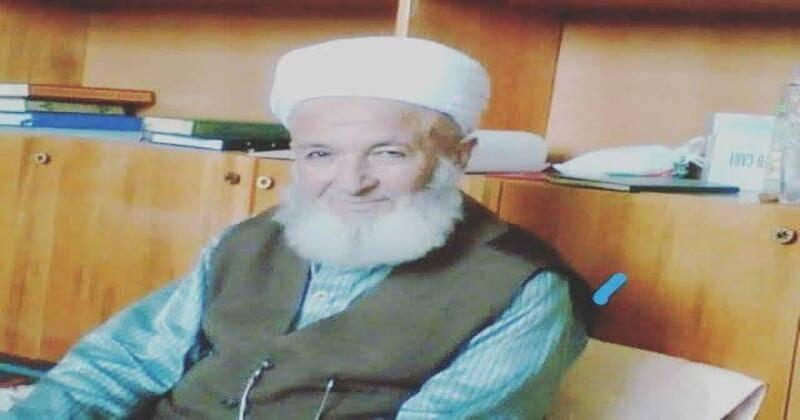
One of the great pioneers of our recent history was Seyda Molla Ibrahim al-Kelhoki (Toprak), a man who devoted his entire life to teaching, cultivating students, and reviving Islam.
With a continuous teaching career spanning nearly fifty-five years, hundreds of scholars trained under his wing, his authorized disciples, his Sufi maturity, and his uncompromising personality, Seyda became one of the most influential madrasa scholars of the last century. Through his knowledge, morality, and stance, he left a profound imprint on the generations that followed.
When looking at his life, one sees thousands of students, hundreds of scholars holding his ijazah (authorization), dozens of madrasas, and a love for knowledge that endured until his final breath. He often forgot his illness, age, and fatigue, living among books and students, declaring, "My cure lies in teaching."
Birth, Lineage, and Family
Seyda Molla Ibrahim was born in 1933 in the Hasankeyf district of Batman. His father was Molla Muhammed Eskifi, one of the region's renowned jurists, and his mother was Havle Hanım, a woman known for her knowledge of jurisprudence (fiqh). Reading legal texts with his mother at a tender age, Seyda partook of her solid intellectual foundation; he read Ghayat al-Ikhtisar, one of the fundamental books of Shafi’i jurisprudence, when he was merely six or seven years old.
By lineage, he was of the Omari tribe, and it is narrated that he descended from Abdullah b. Omar (radiyallahu anhuma). He married Hacı Emine, the daughter of Hacı Ali from the Hacı Raheli family; they were blessed with eight children, one son and seven daughters.
Years of Education and His Teachers
His first teacher was his mother, and his second was his paternal uncle, Molla Ömer Eskifi. Later, he took lessons from Sheikh Fahreddin Arnasi, one of the prolific scholars of the region. Sheikh Cuneyd Zokeydi in Siirt Kayabağlar, then briefly Molla Osman Bileyderi, and finally Seyda Molla Sharif Fersafi—famous for his intellectual depth—played pivotal roles in his scholarly development. He received his ijazah from Fersafi in 1951, while still a youth of eighteen or nineteen. He frequently expressed his admiration for his teacher, saying, "I wish I had known him sooner."
The Odyssey of Teaching
Seyda’s journey of knowledge continued across many villages and cities; wherever he went, he transformed that place into a center of learning:
Madar Village: His initial years as a professor.
Kelhok Village: The eight years he spent here earned him the demonym "al-Kelhoki." His courage in debates and his refusal to compromise on the truth became legendary in the region.
Hüseynîk (Kesikağaç): One of his most productive periods, during which he granted ijazah every year.
Mîreliyan, Fêra, Mara, Fetlê: Villages that each bear the traces of his scholarly abundance.
Menzil (1995–2006): A journey that began with a dream…
The Story of His Arrival in Menzil
In a dream, he beheld the Sheikh known as Gavs-ı Kasrevi, Seyyid Abdulhakim al-Bilvanisi (quddisa sirruhu). There were two children with the Sheikh, who said to Seyda: "These are entrusted to you; give them their lessons!" Seyda replied, "As you command."
Some time later, (Sheikh) Seyyid Muhammed Fettah, one of the children from the dream, came to invite Seyda to Menzil. Upon this sign, he went to Menzil and spent the final eleven years of his life there.
He passed away in Menzil on December 5, 2006. Sheikh Seyyid Abdulbaki al-Husseini led his funeral prayer and eulogized him by the grave with these words: "He was a deeply righteous man. We have not seen such a scholar in this vicinity."
Personality and Character
Freedom at the Center: The core of Seyda’s personality was freedom. A Kurdish saying of his, famous among the locals, goes: "Hefsarê xwe nadim destê kesekî" (I will not surrender my reins to anyone’s hand). This saying is the clearest summary of a character that was independent in knowledge, free in decision-making, uncompromising in truth, distant from worldly benefits, and unconcerned with currying favor.
Generosity, Punctuality, and Work Ethic: For him, the concept of a "vacation" did not exist. He could not tolerate students remaining idle even for a moment. Prof. Dr. Halil Çiçek shares a famous memory: "One day he saw us sitting idly and asked, 'Is today a Christian holiday, that you are sitting empty?'"
Memory and Intellect: He knew the exact page and line of jurisprudential issues within books by heart. Even if months passed, he would not forget where a student had left off. He exhibited extraordinary speed and intelligence in the calculations of Feraid (inheritance law). Even in his old age, he could read the finest Arabic marginalia.
Cleanliness and Order: He paid attention to cleanliness to the point of obsession; if his eye caught even the smallest piece of litter on the ground, he would not pass without picking it up.
His Sufi Aspect
Seyda viewed Sufism not as an obstacle to knowledge, but as the very depth of it. In this respect, he carried both the discipline of the madrasa and the discipline of the tekke (Sufi lodge) together. In the 1960s, he pledged allegiance to Sheikh Masuk (quddisa sirruhu), one of the notables of Norşin. After his Sheikh passed away, he remained unattached for a while, later feeling a deep affection for Sheikh Muhammed Sharif Arabkendi (may his secret be sanctified) and pledging allegiance to him. It is rumored that he had contact with Sheikh Seyyid Muhammed Rashid (may his secret be sanctified) before coming to Menzil. In 1996, he received the khilafah (spiritual successorship) from Sheikh Seyyid Abdulbaki (quddisa sirruhu).
Observing the balance between Sharia and Tariqa flawlessly, Seyda saw these two fields not as conflicting, but as two great spheres of service that completed one another.
Educational Method and Philosophy of Instruction
As a scholar, Seyda dedicated his life to raising students. In his eyes, true knowledge was a labor that lived within books, was digested through study (mutalaa), and united with piety (taqwa).
The Necessity of Preparation: Everyone who studied under him knew: it was impossible to sit for a lesson without prior study. A student who did not prepare was either removed from the lesson or given very little instruction.
Repetition and Negotiation: After the lesson ended, he required students to repeat the text among themselves dozens of times. The essence of the lesson could only settle through repetition.
Intellectual Discipline: He was never late for class; he expected the same punctuality from the student. Whether in the village, at home, or visiting others, it did not matter; when the time for the lesson arrived, everything else was shelved.
The Student's Goal: His ideal student was one who would either become a professor or a religious man acting upon his knowledge to illuminate society. He would say, "He who is to lead society must first rectify himself," imparting both knowledge and morality simultaneously.
Education through Piety: He did not merely teach knowledge to his student; he demonstrated piety, truthfulness, patience, and justice by living them. His life was, from beginning to end, an "applied education."
His Works
Although Seyda possessed a high capacity for authorship, he wrote very few works. When his students asked why, he gave this response: "The scholars before us said what needed to be said. Our duty is to explain their words and resolve issues in the light of their evidences."
His existing works are as follows:
Irshadu’l-Mu’minin ve Ikazu’l-Ghafilin: A concise work on encouragement, warning, and etiquette, written so that preachers and imams might also benefit.
Kitabu’l-Feraid: A short but valuable treatise prepared to facilitate the understanding of inheritance issues.
Kitabu’l-Aqaid: A treatise in Kurdish containing basic Shafi’i catechism information.
In Conclusion…
Seyda Molla Ibrahim al-Kelhoki was not merely a mudarris; he was a man of will, a lover of knowledge, a person of piety, and an architect of character. By dedicating his life to knowledge and the student, he both kept the madrasa tradition alive and established a throne in everyone's heart through his strong morality. Today, anyone looking at his life clearly sees this:
When knowledge is united with sacrifice and piety, a single human life becomes a light for thousands.
Today marks the nineteenth anniversary of Seyda Molla Ibrahim Kelhoki’s passing. We beseech the Almighty Lord to immerse him in the vastness of His mercy and to exalt his station. May Allah the Almighty accept his efforts on the path of knowledge and service, and may He grant us a share in his intercession and abundance. Amin.
AUTHOR
Abdurrahman Hakan Pakiş