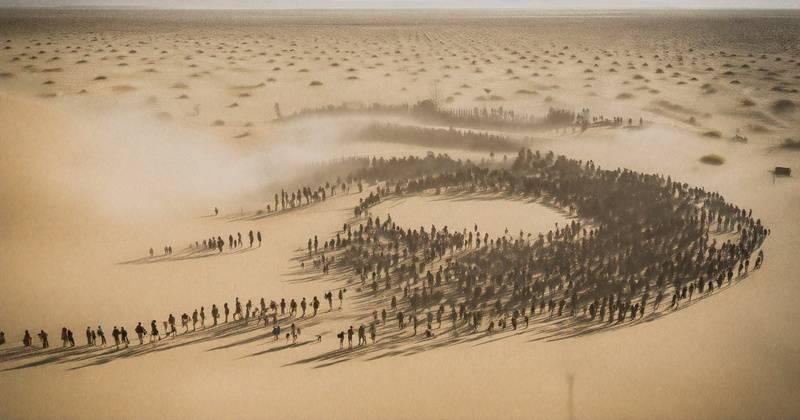

Four years after the journey to Syria with his uncle Abu Talib, when he was around sixteen years of age, the Prophet [sallallahu alayhi wa sallam] traveled to Yemen with his other uncle, Zubayr b. Abdul-Muttalib. During this journey, his calming of a furious camel that no one in the caravan could control, and his guidance of the caravan through a valley submerged in floodwaters, increased the admiration of those around him. This marked his second major experience in the realm of commerce.
When the Rasul-i Akram reached the age of twenty-three, Khadija [radiyallahu anha], the most noble and wealthy woman of Mecca, was seeking a trustworthy individual to manage her caravans. Khadija had, in fact, previously sent the Prophet with caravans she dispatched to Yemen a few times and had been pleased with his method of work. Now, however, the matter at hand was a great caravan bound for Sham (Damascus). Indeed, this caravan was of such magnitude that it rivaled the merchandise of all the Meccans of that era combined.
Hearing of this opportunity, Abu Talib immediately summoned his nephew. Stating their financial insufficiency and their need for earnings, he said, "Let me go and speak with Khadija; since she knows your trustworthiness, let her give you double what she gives to others." Out of respect for his uncle, the Master accepted this proposal, saying, "Let it be as you wish, uncle; you know well that I would never depart from your word nor fail to heed you." When Abu Talib met with Hazreti Khadija and requested double the wage for his nephew, Hazreti Khadija replied: "O Abu Talib! Truly, you have requested a wage worthy of Muhammad [sallallahu aleyhi vesellem]. Had you asked of me many times more, I would have granted it without objection." (Isfahani, Dala'il al-Nubuwwah, 1/178)
Thus, the Messenger of Allah set out with Khadija’s capital. Assigned to accompany him was our mother Khadija’s servant, Maysara. Maysara’s duty was to observe throughout the journey this young man, in whom she sensed a different state. This journey, which lasted three months, is filled with exemplary lessons for modern commercial life.
In the market of Sham, a Jewish merchant, while bargaining with the Master, asked him to swear by the idols of Mecca, Lat and Uzza. The countenance of the Prophet, who until that moment had been gentle and smiling in his trade, suddenly changed. He refused with absolute finality, saying, "Do you call upon me to swear by lifeless objects in which I do not believe and to which I have never accorded value? I shall never swear by those idols, which appear so repulsive to me." (Ibn Sa’d, Tabaqat, 1/135). This stance astonished the Jewish merchant and everyone in the market of Sham.
Another event witnessed by Maysara on the same journey is as follows:
While the Prophet was occupied with accounting matters, Maysara asked, "O Muhammad, what have you been doing here for hours?" The Prophet spoke thus: "O Maysara! I had separated the caravan’s accounts from my own. Yet, somehow, a small confusion has occurred. I do not know if the caravan’s money has mixed with mine, or mine with the caravan’s. Rather than flounder further in this doubt, witness now that I add all my own funds to the caravan’s capital. Better that dozens of my dirhams pass to the caravan’s account than a single dirham of the caravan pass to mine." (Ibn Sa’d, Tabaqat, 1/130). Maysara was left in awe of this sensitivity displayed by the Prophet.
Upon their return, in response to this honesty and success, Khadija (radiyallahu anhha) gave him more than the agreed wage.
The Partner of the Prophet
In the early years of Islam, the Messenger of Allah had a partnership with Saib b. Abu's-Saib [radıyallahu anh]. When Saib became a Muslim on the day Mecca was conquered, the Master welcomed him, saying: "Welcome to my brother and partner, who never deceived anyone, never quarreled, and remained faithful to the ties of kinship! The deeds you performed in the Era of Ignorance were not accepted from you then. But today, those behaviors are accepted from you because you have become a Muslim." (Ibn Sa’d, Tabaqat, 6/93)
In another narration, when the companions attempted to introduce Saib to the Master, the Messenger of Allah declared, "Do not attempt to teach me of him. He was my companion in the Era of Ignorance. I have known him since those days." (Ibn Hajar, al-Isaba, 1/684)
Throughout his life, Saib would always recount what a perfect, uncontentious partner the Prophet was, saying, "In the Era of Ignorance, the Messenger of Allah was my partner. He was a most excellent partner. He never quarreled, nor did he ever engage in vain wrangling."