Left to his own devices, without a principle to anchor his actions, man is a being prone to corrupting first his own inner world and subsequently the fabric of societal life. For this reason, to maintain order both within and without, man is in perpetual need of a warner, a guide to discipline the soul. We can discern this clearly by looking at history, particularly at those eras when humanity progressively degenerated and grew cruel. I believe that a glance at the history of the prophets largely suffices to comprehend these periods. For every prophet is a warner tasked with calling man, who has become detached from his essence, back to his true origin. They are the ones sent to realign man—who has lost his principles and thus his morality—whenever social life becomes increasingly inextricable.
For instance, at a time when humanity stood on the brink of serious corruption, Prophet Isa [alayhissalam] was sent as a warner; through him, the Almighty cautioned mankind. While some heeded this warning, others turned away. Upon the completion of Prophet Isa’s duty, humanity, left without a shepherd, soon reverted to old habits, establishing a new order where disbelief manifested in various forms. Indeed, during the interregnum of approximately six centuries between Isa [alayhissalam] and the Rasool-i Akram [sallallahu alayhi wa sallam], many superstitious beliefs emerged. In this era, polytheistic religions, idolatry, and shamanism were at the forefront. Every belief system that leaned upon shirk (associating partners with Allah) and distortion imposed a way of life, and the vast majority of humanity was crushed under the weight of these impositions.
Considering the messengership of the Rasul-i Akram in this context allows us to understand the necessity of the transition from multiplicity (kathrah) to unity (wahdah). The Messenger of Allah abolished all superstitious beliefs, inviting people to gather around the same principle of truth, and desired that all colors be clustered around unity. The all-encompassing messengership of the Rasul-i Akram [sallallahu alayhi wa sallam] is the final great warning directed by Divine Mercy toward humanity and represents the most correct way of life for mankind. Consequently, to understand the process of messengership and Mecca’s importance in this regard, one must look closely at the region's historical process.
Mecca Before the Prophethood
Until the sixth century of the Christian calendar, Mecca could not become a distinct political or economic power due to unfavorable geographical conditions. For this reason, the Meccans lived a life closed off within themselves, largely removed from the political turbulence of the region. This society, molded largely by Bedouin culture, formed its own unique culture within a humble and austere existence.
On the other hand, Mecca and its environs played host to many different faiths. This diversity in Mecca, where the majority were idolaters, was a significant factor that would serve the city’s rise in the future. Because of its location unsuitable for agriculture, Meccans engaged in small-scale commercial activities. Though limited, Mecca experienced a certain vibrancy during specific times of the year. However, the great war between the Roman and Sassanid empires in 502 AD caused affairs to change completely.
The most pivotal development that paved the way for Mecca was the dispute over the Silk and Spice Roads between these two great powers. The fact that these routes were under Sassanid control—managed by a single hand—disturbed the Roman elites. Their weakness for ostentation had become dependent on goods arriving from the Sino-Indian geography. The addition of economic problems to the political and military crises between the two states led to a massive war.
Due to this war, finding a new trade route became inevitable. Rome wished to prevent the strengthening of the Sassanids by ceasing the payment of high taxes to them. They found the solution in a new route over Arab lands, utilizing the Red Sea. Goods from the East would no longer pass through Sassanid-controlled lands but would be transported via the Red Sea to Abyssinia, and from there to Mecca. The distribution of commercial products would then extend to Roman markets through Abyssinia-Mecca cooperation, under the control of the Quraysh. The year 502 of the Christian era marks the beginning of this process. With the new route, Sassanid influence would be broken, the Arabian Peninsula would be revitalized, and the Arabs would gain renown in trade. in short, Mecca would cease to be merely a junction and would become a center.
These new trade routes would also provide great conveniences for the Muslims during the years of the Revelation. For example, during the migration to Abyssinia, the noble companions waiting at the port of Shuwaybah would travel on one of these merchant ships operating on the Mecca-Abyssinia line. At the same time, during the years of the mission, these active and secure trade routes would offer the noble companions the opportunity to travel to many places for the purpose of tabligh (conveying the message).
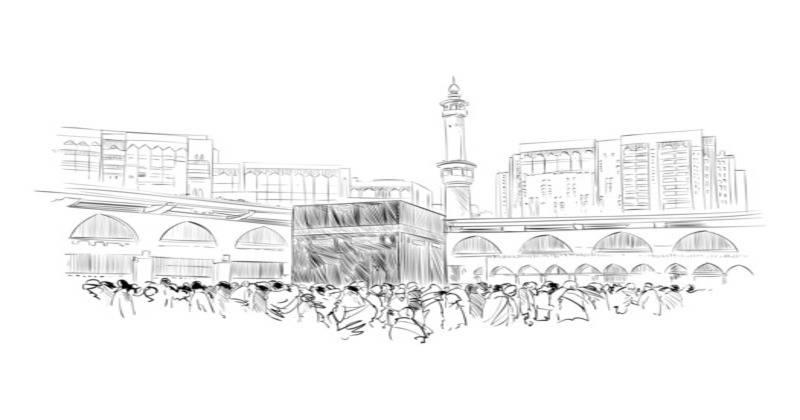
At the center of Mecca, the Kaaba stood out far beyond this commercial and political activity as the first sanctuary, the first House (Bayt) built on earth for humanity with the intention of worship. This blessed structure, described in the Qur’an as a source of blessing and guidance for the worlds, is the most concrete sign on earth of the legacy of prophethood and the belief in Tawhid continuing since Adam [alayhissalam]. Although its walls may have been destroyed from time to time throughout history, its foundations were raised upon piety (taqwa) by Ibrahim and his son Ismail [alayhimassalam] themselves. The Kaaba, as an earthen sign of Allah’s Oneness (wahdaniyyah), possesses a divine gravitational pull that gathers people to a single center. Thus, even when surrounded by idols, it never lost that essential light within, nor the honor of being "Baytullah" (The House of Allah).
The religious and political influence of the Kaaba can also be seen as a significant factor fueling Mecca’s density. The fact that the Kaaba was surrounded by idols and harbored different beliefs drew people there, increasing the commercial gains of the Meccans. At the head of this trade network during that era stood Hashim, one of the grandfathers of the Rasul-i Akram [sallallahu alayhi wa sallam], and his companions. The system they established was managed with great skill across the Rome, Sassanid, and Kaaba axis. The fact that the commercial activities under his leadership extended into the heart of Anatolia demonstrated the power of Mecca and the Quraysh in the region.
It was difficult to sustain a system that had grown so large. Consequently, the Meccans resorted to various measures. These measures were the milestones on the road to becoming a small but effective city-state. These were agreements and formations such as "Ilaaf," "Hums," and "Hilf al-Fudul." Ilaaf referred to security agreements made with tribes along the trade routes. Hums denoted the set of rules determined for guests visiting the Kaaba. Hilf al-Fudul was a structure of solidarity formed to ensure that both commercial activities and social relations continued on a foundation of justice and trust.
Briefly, these are the material reasons for Mecca’s rise to a central position prior to the Prophethood. However, we need to understand better the condition humanity was in before the call; what all of this prepared the ground for; and what the Rasul-i Akram [sallallahu alayhi wa sallam] was up against. And this is related to how idolatry became widespread and what it signified.
The Spread of Idolatry in Mecca
We can trace the origins of associating idols with faith back to the era of Nuh [alayhissalam]. As for the arrival of idols in Mecca, tradition ascribes this to one of its ancient chieftains, Amr b. Luhay. He first encountered the culture of idolatry when he traveled to the lands of Sham (Syria) seeking a cure for an illness. The reverence people showed to images wrought by their own hands captivated him, and he desired to transplant this custom to Mecca. He placed the idols he brought from Sham around the Kaaba. Subsequently, by commissioning a separate idol for each tribe, he sought both to bind them to this culture and to reinforce the sanctity of the idols. Over time, practices remaining from the Abrahamic tradition began to exist side by side with idolatry. During this process, although some deluded themselves into believing they still adhered to the faith of Ibrahim [alayhissalam], they had long since made these idols a natural part of their belief. The thought of Tawhid (monotheism) slowly began to lose its influence, replaced by a corrupted, distorted concept of divinity filled with absurdities.
The filling of the Kaaba with idols and the tribes coming to worship at specific times were parts of this transformation. The Meccans gradually attributed broader meanings to the idols, eventually crafting an idol for almost everything. Believing that these effigies aided them in matters such as tranquility, fertility, peace, abundance, and health, they fashioned some in human form and others related to nature. Spreading into every area of daily life, idols became the very social character of Mecca. Thus, considering Mecca's location and the historical weight carried by the Kaaba, idolatry was inherited across generations as an ancestral legacy. The behaviors, worship, and social relations of the Meccans were determined by the meaning they ascribed to these idols. In time, this also settled at the center of commerce. Coming to the Kaaba to visit the idols carried the value of worship. Consequently, idols continued as a tradition that generated revenue, attracted vast crowds, and possessed specific rituals until the process of the Risalah (Prophethood).
Mecca of the Jahiliyya (Age of Ignorance), though not a colossal center of civilization, constituted a sharp example of that ominous "elite-commoner" dichotomy that permeates everything from ancient capitals to the most remote villages. In this order, the elites were privileged and untouchable; the common people were valued only to the extent that they could serve this class through taxes or physical labor. In truth, it was shirk (polytheism) that fed the ontological ground of this deep societal rift. For the beliefs of the ancient era were largely systems constructed to legitimize the power of the elite. The idols were not merely metaphysical figures but symbols of power representing dominion. This is the fundamental motive lying in the background of mankind’s rapid drift away from Tawhid throughout history. Those lusting for power have strived with all their might to destroy the belief in Tawhid, which renders them equal to the common people, or if unable to destroy it, to deform it. This situation is, unfortunately, the story of modern times as well.
The history of humanity is, in essence, the history of man’s transactional relationship with the material world. In Meccan society, the increase of wealth walked hand in hand with the anxiety of protecting it, and all injustices were born of this relationship of interest. The fact that it was a trade center for great states on one hand, and a place where different faiths coexisted on the other, combined with the pursuit of highly profitable activities, had severed them from moral principles. It reached such a point that they had eyes for nothing but themselves. The distinction between truth (Hakk) and falsehood (Batil) had vanished. There remained only one event to occur before Mecca could enter the shadow of the Prophethood. That was the mobilization of Abrahah to destroy the Kaaba, driven by his desire to share in this rampant excess.
The Year of the Elephant: Abrahah’s Attack on the Kaaba
The central role of Mecca and the Kaaba disturbed the Governor of Yemen, Abrahah. The flowing of thousands of people to Mecca and the Meccans’ command over the lion’s share of trade forced Abrahah to respond, to issue a challenge. A strict Christian, Abrahah desired people to come to Yemen instead of Mecca as a center of faith. This aroused in him the desire to build a magnificent temple. In the construction of this structure, built as an alternative to the Kaaba, he used stones and ornaments brought from the Roman Empire. Despite this, the desired effect did not materialize, and his anger grew. The fact that an Arab, enraged by the construction of an alternative to the Kaaba, went and defiled that building drove Abrahah completely mad. Thereupon, Abrahah organized an army and prepared to set out to destroy Mecca’s commercial position and the spiritual power of the Kaaba. His intention was to slaughter the Meccans and raze the Kaaba.
The presence of a great elephant in Abrahah’s army signified that the Kaaba was the target. Thus, the Meccans began to seek a remedy. Upon Abrahah’s army stationing itself in a region near Mecca and seizing some herds of camels, the city’s notables, particularly Abdul-Muttalib, sought to meet with him. In the meeting, Abdul-Muttalib demanded the release of his camels. Abrahah, astonished that he cared for his camels while the Kaaba was under threat, asked the reason for this. Abdul-Muttalib replied that the camels belonged to him and he was obliged to protect them. He then stated that the Kaaba also had an Owner, and that its Owner would protect it. At this, Abrahah’s rage intensified. For seeing someone, from whom he expected fear, possess such confidence with a calm and determined demeanor appeared to him as a challenge. The attack was beginning.
When the order was given to move, the refusal of the elephant to budge, and its changing direction whenever they tried to force it, brought joy to the Meccans who had taken refuge in the high places. Just as the Governor of Yemen, Abrahah, mad with rage, launched his attack with all his might, a terrifying roar broke out that no one had expected. A flock of birds, the nature of which they could not even comprehend, rained down torment upon the army from overhead. The vast majority of the soldiers perished in that instant, while the remainder lay dying in agony. Although Abrahah barely escaped with his life from this event, he too died shortly thereafter.
In short, all these political, economic, and sociological transformations Mecca underwent, and the preservation of the Kaaba in the Incident of the Elephant, are a manifestation of Divine Destiny (Qadar-i Ilahi). Just as the Almighty protected the Kaaba from physical attacks, He was very soon to purify it from spiritual impurities as well. A short while after the Incident of the Elephant, the Rasul-i Akram [sallallahu alayhi wa sallam] would grace the world, and Mecca would be cleansed of shirk and clothed in the raiment of Tawhid.
AUTHOR
İbrahim Orhun Kaplan